Now that I am in the 11th week of teaching, I have finally had some time to make some classroom observations as well as gather some more photos of other school-related activities. As a reminder, the school that I work at is a primary school. It’s not a government public school, though; it’s a private primary school. The campus itself actually has two different schools: one is the main international primary school, and the other is the bilingual primary school. I work at a bilingual primary school. There are also several international kindergartens associated with our school, but they are not on this campus (they are maybe a 5-minute drive or so from our school). I spent my first year in Hangzhou cutting my teeth at a training school. After a year of that, I decided that I wanted to try working at a “real” school where the emphasis was more on learning than making money for the school.
I teach mostly Grade 4, but I also have several Grade 6 classes. Every class has an oral lesson and a listening lesson (the Chinese teachers do the reading, writing, and grammar lessons in other classes), which are 40 minutes each. Though my day usually starts at 8:15am, some days my other classes don’t start until 9:05am. Our lunch break is (wait for it, and try not to get too jealous) from 11:45 a.m. until 2:30 p.m. Boom!
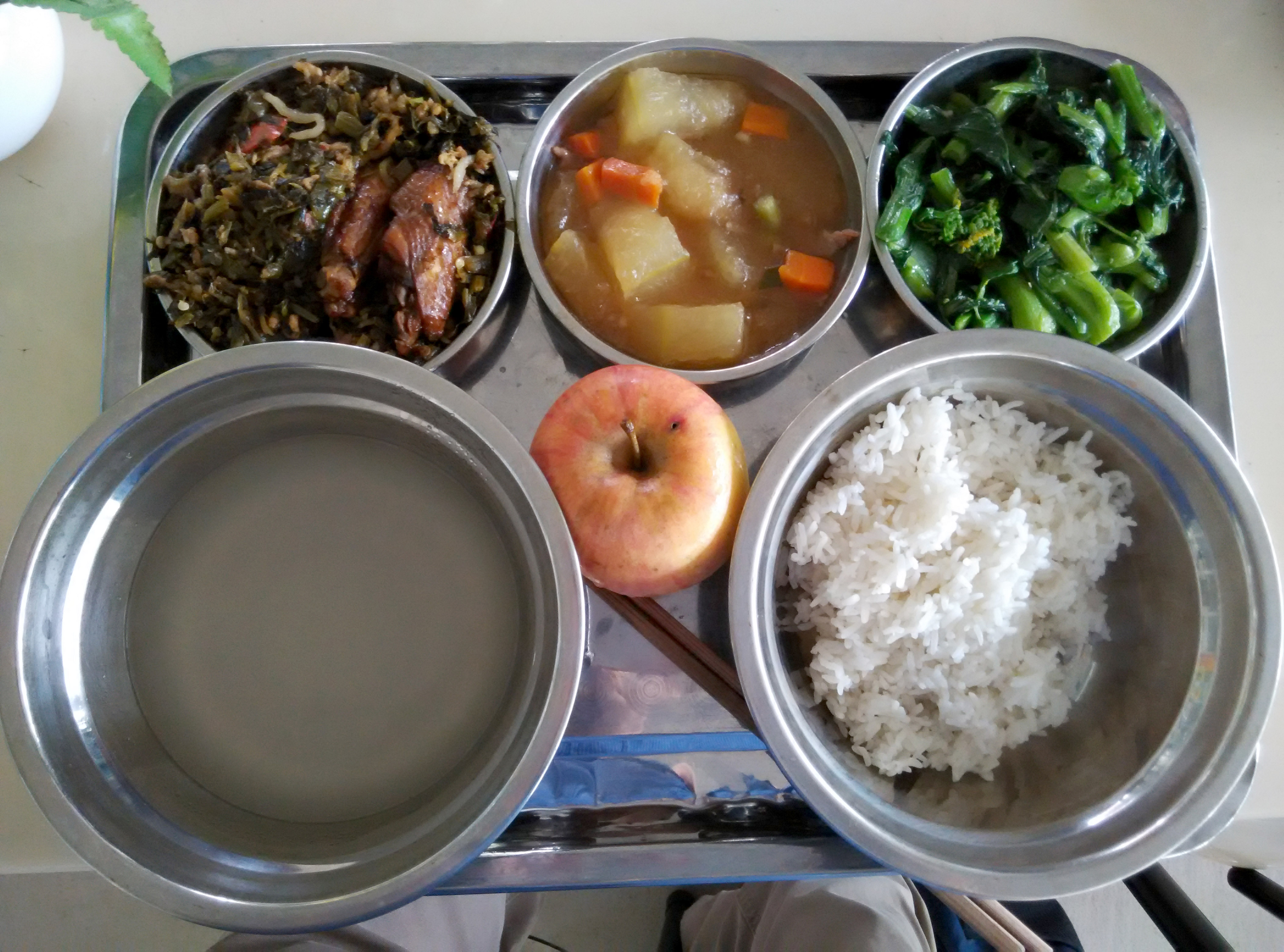
A sample lunch from the canteen (people here don’t seem to use the word “cafeteria.”). From the top left: chicken wings with minced veggies and peppers; some kind of braised melon and carrots; Chinese greens. There is also always rice, a broth soup, and some kind of fruit. They also have little boxed drinks such as red bean milk, wheat milk, and regular milk. Chinese employees must pay, but the foreign teachers eat breakfast, lunch, and dinner for free (at least currently). Who knows what the future holds?
The kids have lunch and then nap time until sometime after 2:00 p.m.In the mornings, there are up to four classes. At 2:30 p.m., the afternoon classes start (of which there are up to two). On Wednesdays, the bilingual school teachers have the afternoon off. The international school teachers have only one or two lessons per day, but they must do their office hours and go out on the field with the kids from 5 p.m. to 5:30 p.m. Our day ends at 4:00 p.m. (sometimes). But hey, they also get paid a lot more, so… It’s nice to have real weekends and evenings off. At the training center, I had two days off, but they were split (Tuesdays and Fridays), which didn’t allow much time to travel. Anyway, onto some more specifics.
Uniforms
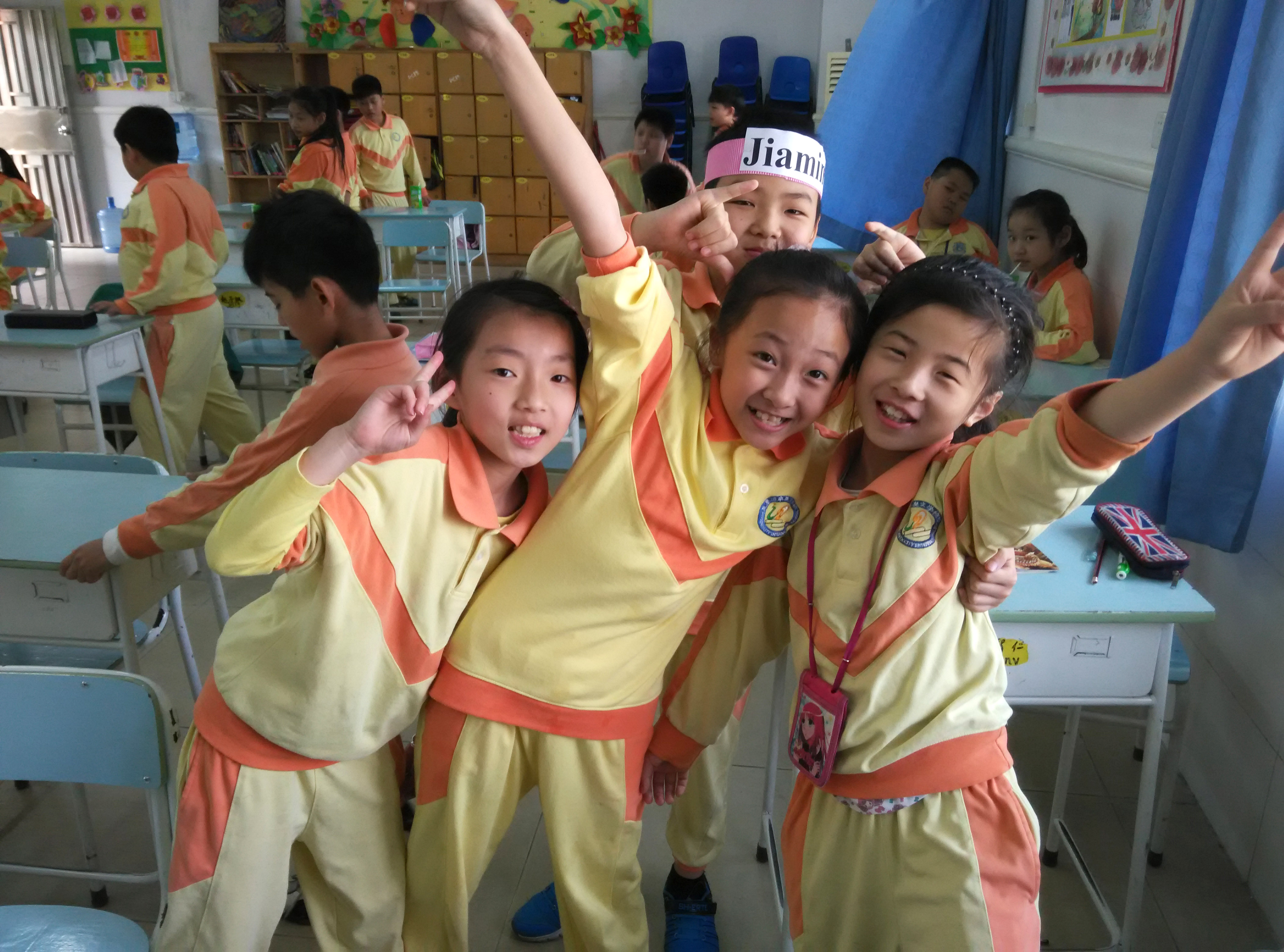
Yes, here the kids wear uniforms. But they are not what you might expect. When I say uniforms, I guess I should refer to them as uniform sweat pants outfits. They have long-sleeve sweatshirts and sweat pants that come in two color combos: one is yellow and orange, and the other is green and white. The majority of them are still wearing long-sleeve shirts and pants, even though the weather is getting hotter and more humid. I was told that the kids don’t really start to wear their shorts and t-shirts until maybe June. Sometimes you can see dirty stains on them too. Not exactly the school outfits we think of in western schools.
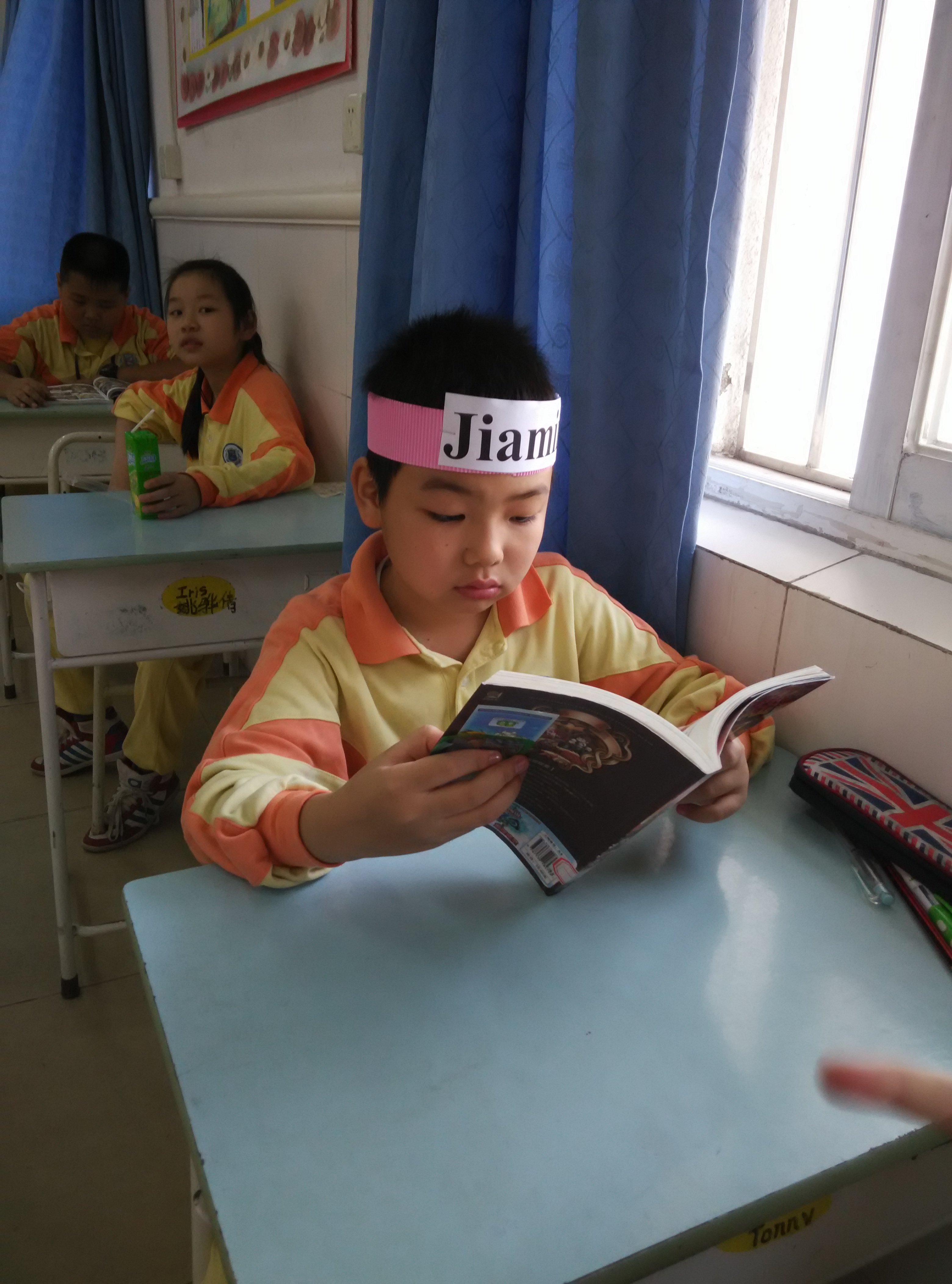
I see a future in fashion design, perhaps.
 Daily Exercise
In addition to having their regular physical education classes like we do back home, they also have their daily exercise in the morning, and then in the late afternoon, they have play time on the field and playground. In the morning, they run a few laps around the track (the Chinese teachers included). After which, the kids return to the classrooms and have their drinks or snacks. If the weather is rainy, then they play a video clip of exercise moves, and the whole class follows. The vast majority of the kids are thin or just slightly pudgy. Nothing compared to the overweight (and even obese) kids that are becoming an epidemic in the west.
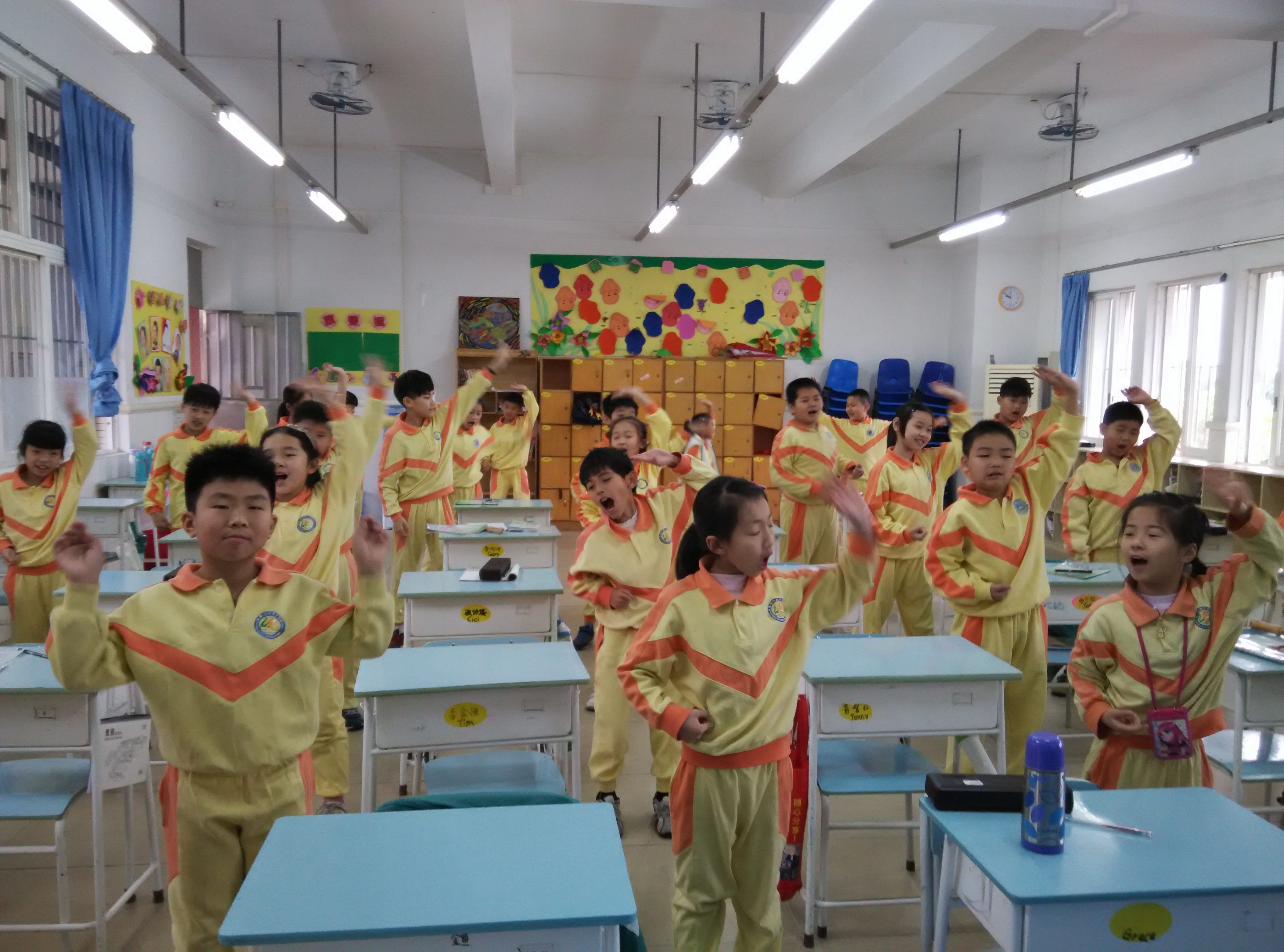
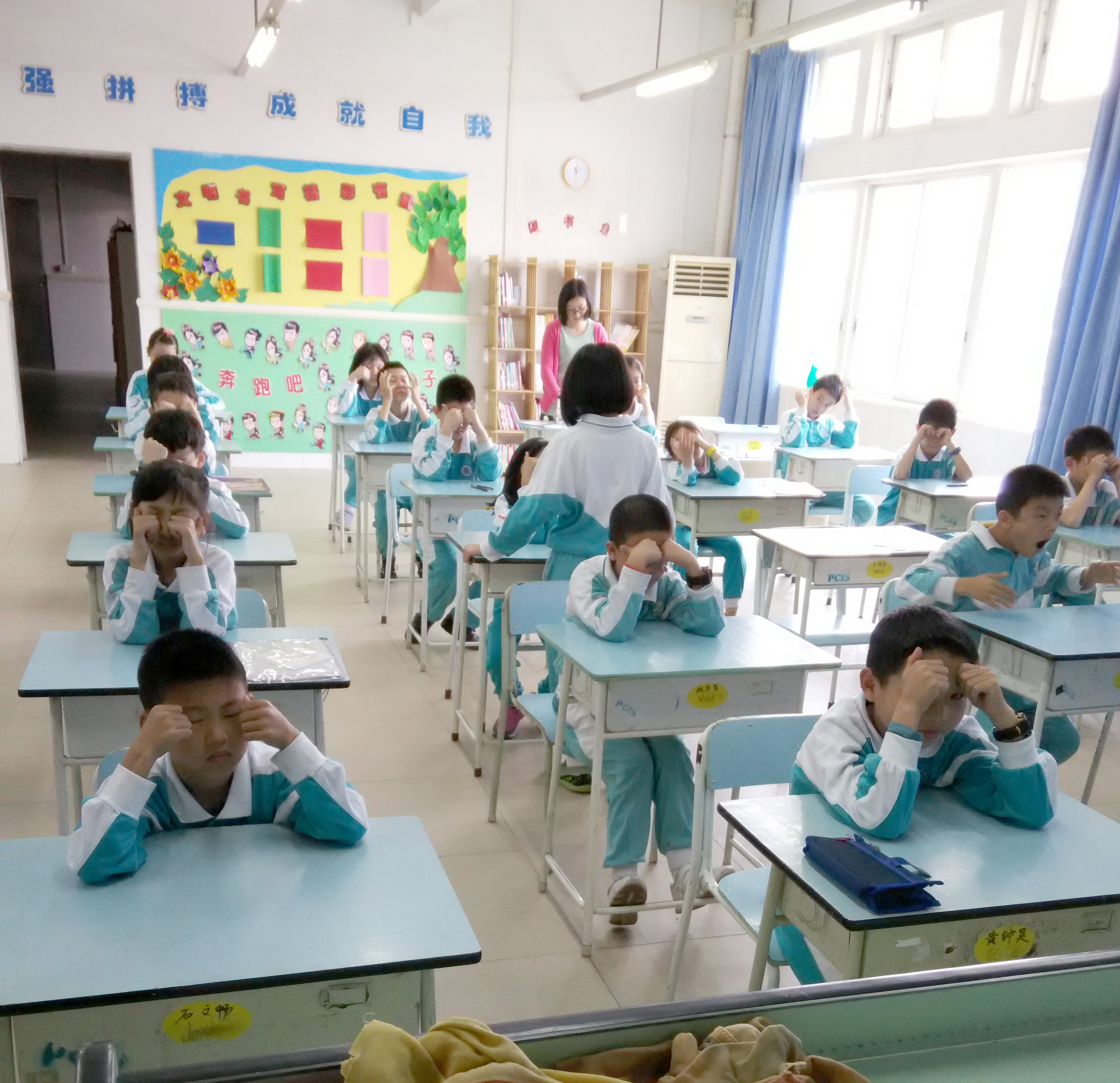
 In addition to going out for exercise, the kids also have a daily ritual of listening to “calm, meditative” music where a woman counts to eight and the kids commence rubbing their temples, eye areas, and nose.
As part of the duties of the foreign teacher, we have an “English Corner” session once a week after school from 5:00 p.m. to about 5:25 p.m. or so, though it used to be during the kids lunch time. Normally it would be a time to do some extra-free discussion practicing with the kids, but this is during their play time, and the kids aren’t about to sit down quietly to practice speaking. So rather than attempt and inevitably fail at that, I try to do a physically active game that incorporates a tad bit of speaking (that’s honestly the most you could possibly get from them since they are so hyperactive at this time). When I try to explain the rules, I can barely get them all out because the kids keep talking and moving around and not paying much attention. Currently, I’m using the game “Red Rover.” It starts with two kids holding each other’s hands and saying, “Red Rover, Red Rover, _______, come over,” and they choose someone to run over and try to break through their grip. If they do, then they are safe and will return to the group. If they don’t, then they must join the human “fence.” Luckily, the kids seem to enjoy this, and almost everyone is eager to participate.

Kids names
Back when I was in Hangzhou, I had plenty of kids that had the oddest English names. Here in the primary school, I find that perhaps the majority of the kids have more normal English names, but there are still some strange ones. I have actually seen some kids’ desk name tags that say “Yum,” “Juicy,” “Veal,” “Dicken,” “Darry,” “Dank,” “Kaka,” “Rabbit,” “Bobo,” and “Super.” I really don’t know what these parents are thinking or what source they are getting these names from.
School Activities
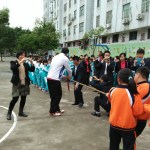
While I have been told that occasionally there will be school-wide field trips, I have yet to go on one. However, I was asked a few weeks ago to go with the 4th grade classes (after school) to a public school downtown for some kind of school meet-up. I guess the point was to get the two schools to meet each other and make friends. The kids started by exchanging little gifts and chatting, followed by a few rounds of tug-of-war. Being the only foreigner there, I just basically chatted with some of my students while waiting for the tug-of-war.
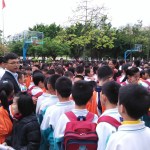
-
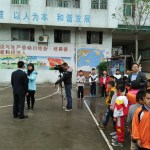
- The camera crew begins filming…
-

- …the kids slowly noticing that there is a camera crew…
-
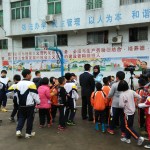
- …and still more kids start noticing and begin to descend.

-
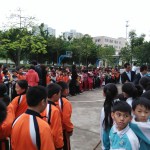
- Sharks vs. Jets
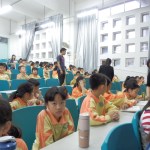
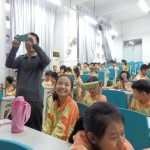
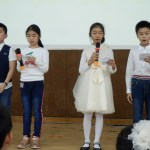
Recently, we also had the first round of their annual speech competition. I don’t know how many semi-finals there will be, but this may last all the way until June. This took place in one of the auditoriums (one that is not that frequently used). I could tell by the large holes in the wooden floor on stage that they looked like potholes or craters. The kids all wore numbers, and us judges were given slips of paper to fill out and score.

-

- The hosts for the evening
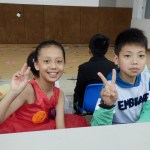
-

- “Coco” got a hold of my camera.
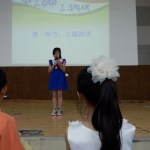
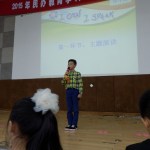

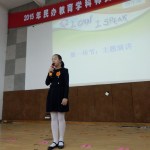
-
- Up, close and personal
Some students were better than others, but most did a good job. A few choked a bit and couldn’t finish their speeches. It seems that the lives of the Chinese are full of competition of every sort.
After I left, it wasn’t until around 8 p.m. that I realized that I had left my USB in one of the classrooms. Luckily, the classes were still open, and I found them. When I did, some of the students were there just getting out of their final class (yes, I’ll talk more about this later). One of them from the competition (the one named “Dank”) saw that I had my camera and said I should take his photo because he “is so cute.” Well, when a smart, cute kid like that says that they are “so cute,” it’s difficult to argue.
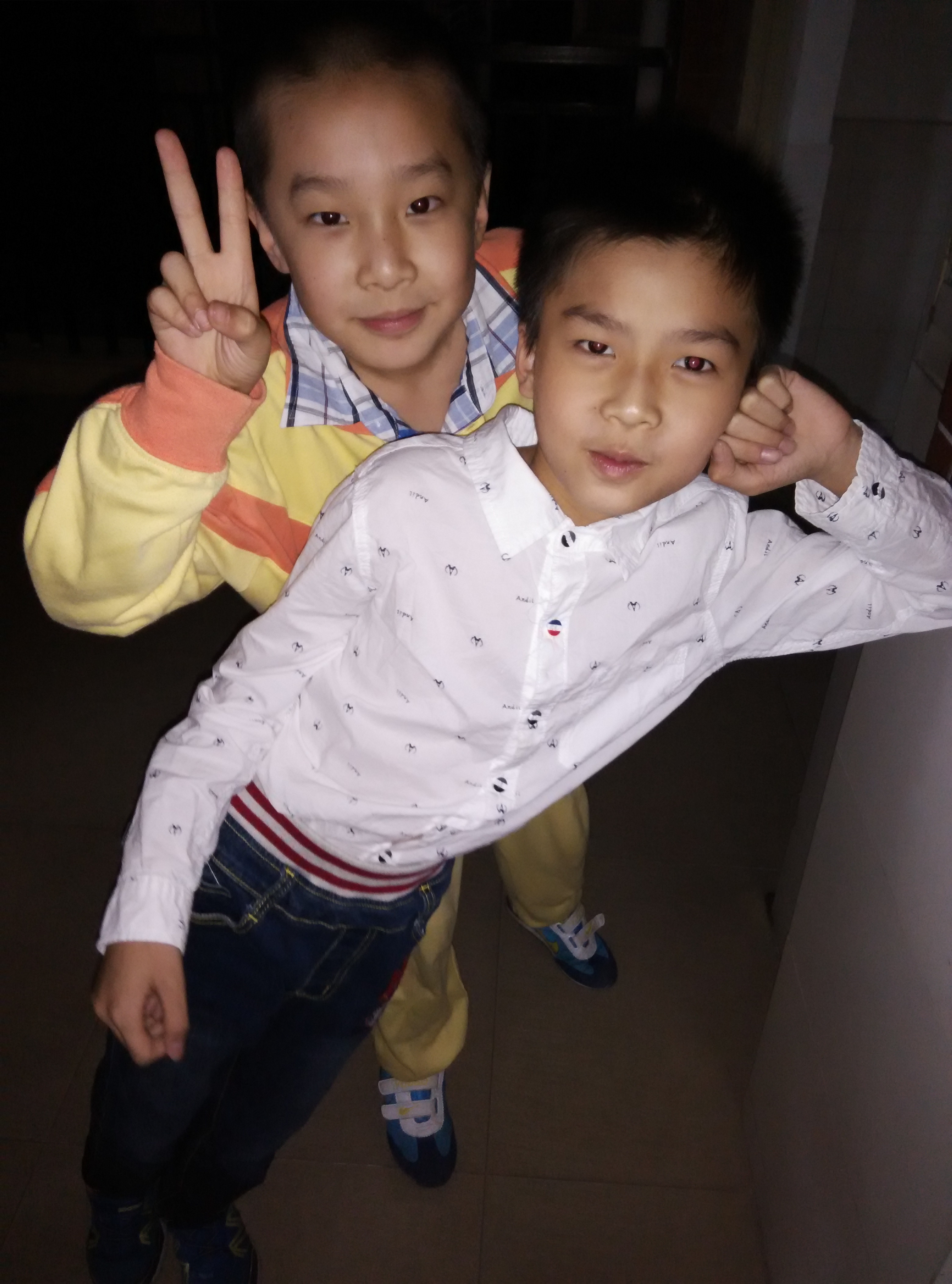
The oh sooooo cute “Dank” in his white shirt.
Western Methods vs. Chinese Methods
When it comes to managing the classroom, this is where the differences between east and west really show.
Behavior
I’ll start by taking a look at the behavior of the kids. The fourth-grade kids are, for the most part, sweet and full of energy. Some classes are clearly better than others in both English skills and behavior, but some classes have kids who display more laziness and lack of English comprehension than others. In China, teachers are respected much more than they are back in the West. Kids here don’t seem to be able to stop talking, though, no matter how many times I keep “shhhhuushing” them or just flat out yelling at them to stop talking. I rarely do this, though, because it creates an uncomfortable atmosphere in the class and also puts more strain on my vocal chords. As it is, there are too many kids in each class, and I have to speak loudly just to keep their attention. Some of the kids that I thought were just being lazy or didn’t know English very well have begun to open up more (though, of course, every day is different). I start off each class with “good morning everyone,” followed by (mostly) “good morning, Mr. Greg.” I may have mentioned before that they refer to me as “Mr. Greg,” and I don’t correct them. First, I think it’s just easier to say “Greg” than to say my last name, plus they are still addressing me in a formal manner by saying “Mr.” Also, I just think it’s cute.
The things that I don’t find cute, however, are when I hear some of them swearing (in English). I’ve heard them say things like “shit,” “ass,” and even “fuck you.” They have never directed these words at me (at least not to my knowledge), but they also don’t seem to care if I or the Chinese teachers hear them. I must admit, when I was in 4th grade, I too started to swear (sorry for anyone who might be shocked by this). However, I at least exercised caution so that I did not swear near the teacher and get caught.
When it comes to bad behavior such as this (and other behavior, like blowing air into their plastic book packets to inflate them like pillows or drawing in their workbooks instead of paying attention), there is surprisingly little disciplinary action. I don’t mean by me, but rather by the Chinese teachers and the school. Of course, some of the Chinese teachers will yell and tell them to stop doing that (some much more forcefully than others), but there is little else that they really do. Some will make the kids stand up at their desk for a few minutes. When we had our most recent teacher meeting, I asked the head Chinese teacher what the policy was for discipline. She said that we should try talking to them but that there is no “punishment.” In other words, you can’t send them outside of the class (in general), you can’t make them stay after the class or after school, and there is no kind of suspension or expulsion to my knowledge (this is, after all, a private primary school), which means parents are paying large sums to have their kids go here. (The Chinese will do what they have to keep their money.).
On the flip side, I have seen some teachers get physical with some students. By this, I mean things like rolling up their books and hitting the students (not too hard, though), pinching their cheeks, yanking their arms, or pulling at their shirts. This is a total 180 from western practices, for which we all know one could quickly lose their job over such things. I have had to yell occasionally, and that usually does the trick. I will also sometimes hit my desk and/or just stop and give them my look of death (hey, if I was born with a stern face, then I may as well use it when needed).
On a final note, kids here don’t seem as mature as similar-aged kids back in the west. Here, the kids seem a bit less grown-up and more naive. I guess this is a mixed blessing. Here they will cry over things that kids back home don’t usually cry over (such as getting into fights with other kids or having trouble with their school work). They also have rather bad social habits, including (but not limited to) openly picking their noses (and some eat their boogers), sneezing and coughing without covering their mouths (adults here also do that), and of course not listening when I tell them to stop talking. Kids here just can’t seem to shut up easily. They do, however, display more eagerness to play games and participate (whereas some kids in the west are not as easily amused by certain things).
Teaching Styles
Western education (typically) is more concerned with teaching students how to think, while Chinese education seems more focused on repetition and memorization. I had one of my Chinese teachers ask me after class if there was anything I could think of that would help the kids improve. I explained how I like to use gestures along with my descriptions of words, as well as using lots of pictures of the words so that the kids understand what the word is. She had wondered which was more important: getting the kids to memorize the words or understanding what the words are in Chinese first. I said that I think it’s important that the kids understand what the words are in Chinese first so that they can better internalize and recall the meaning. For their upcoming spelling test, she wondered what would be good to help them remember. She mentioned briefly practicing the words before each class, and I thought that was a good idea. However, at the beginning of the following class, she just had them take out their vocabulary lists and say each word twice (in a typical, almost “drill sergeant” sort of manner). I guess I can see how this might be helpful with pronunciation and visual/audial memorization, but I failed to see how this would help them to be able to spell these words. I think it would be more helpful to have the kids actually practice writing some of these words at the beginning of class each time rather than just saying them. I may have to suggest this again, but we foreign teachers also walk a fine line in terms of appearing like we are overstepping our bounds when discussing teaching methods that differ from theirs.
Within the first few weeks of teaching Grade 6, I could tell that I would be butting heads with the Chinese teacher of that class. She has been here for maybe 10 years or so, and I am the new, younger foreigner, so I’m sure she thinks that deep down she knows what’s best. Anyway, at one point we had two weeks in a row where we had a day or two off, and so those classes were cancelled. She suggested that for the second week in a row, we should continue using material from the previous week instead of moving on to the next week’s material. We briefly discussed it, and I made my confusion known. I finally had to ask the grade 6 head teacher what to do, and she said that she agreed with me that we should be moving on to the next week’s material and that she had talked to my Chinese teacher about it. I could tell that this did not go over well with the Chinese teacher, and I think ever since then there has been an unspoken resentment towards each other. She has now officially taken over as the teacher supervisor of the bilingual school (the other one went on maternity leave recently), and though we have not had any formal arguments, I have noticed that she has not bothered supplying me with the following week’s materials on time. I have had to ask the head teacher for these. I don’t know if it’s just flat-out payback or if she is just too busy (and a bit incompetent). I’m hoping it’s the ladder, but either way, this does not jive with me.
Anything related to planning ahead
The Chinese seem to think that it’s fine to procrastinate and then scramble at the last minute to get things together (though I have read other ESL teachers stories about how the Koreans are also like this). I remember that while I was in Hangzhou, the same thing would happen. We would not be told about schedule changes or event activities until the night before or even sometimes the day of. I remember when the wife of one of my coworkers made the comment that “life is not planned.” I also met up with a guy who is half Thai and half Taiwanese (but grew up in China) and thought that I thought too much about planning my schedule (he, of course, is the complete opposite and never seems to plan anything). I simply prefer to help myself out by paying attention to details that could help me out later on.
At the school, we often complain to each other about being told things at the last minute and expected to just do whatever at the drop of a hat (even though the Chinese teachers know about them but just can’t be bothered to be considerate and let us know). Fortunately for me, my grade 4 head teacher is pretty good about telling me things roughly a week in advance.
Teaching Material, Classroom Items
Since this is a private school with parents paying tuition, you would think that the facilities and classroom equipment would look and operate like they would in a western private school. But alas, the classrooms look quite ordinary (if not a bit shabby). On the positive side, the classes do have a standing A/C unit in the back, 6 to 9 ceiling fans that rotate (though a few of them don’t work), a projector, and chalk boards (sorry, no whiteboards here) that slide up and down. On the negative side, some of the curtains are shabby and have fallen off of their track a bit, the speakers are old and have the bass turned up too high (sometimes the speakers are placed inside of the desk unit instead of facing outward so the students can hear better), some of the projector screens have gunk on them (in one of the classes it looks like someone splattered brown paint or something all over it), and some of the students’ chairs are missing backs. I think there is only one repair person, and of course they are always busy.
For the listening classes, we would use a cassette tape to play the recordings (yes, they still use cassettes here for some things). This proved to be an annoying process because we would always have to wait for the Chinese teacher to try to get the tape in the correct spot. Sometimes the tape would not be in the classroom, and we would have to ask one of the students to use theirs. Only the teacher supervisor (the head teacher of all the teachers in the bilingual school, who was also my Chinese teacher in one of my classes before going on maternity leave) finally brought in her own CD player. None of the other teachers seemed to have one. My grade 4 head teacher tried to make MP3 recordings from the cassette, but it didn’t work. When the students got new books that came with tapes and CDs, I decided (after a couple weeks) that I would just rip the CD tracks and put them on my USB. This has proven to be a much better solution. Recently, I have had issues with the speakers in one class stopping working correctly, and in another room, the projector bulb was dying out, and I was unable to continue showing the movie clip during the listening class. I was told early on that the listening classes used to be held in one of the computer labs that has earphones at each desk, but because of faulty equipment, they decided to stop having classes there and just do them in the regular classroom. Siiighhhhhh….
Students Who Need Help or Have Problems
Unlike in western schools, where students usually have a teacher aide in the class for kids who have learning or physical disabilities, there are no such teacher aides here. This is a real shame, and I feel bad because the students who need more help or have some kind of behavioral issue are usually just left to their own devices during class. One student who is hard of hearing doesn’t receive help from the Chinese teacher, and I was told that he cannot participate in speaking and listening (but that he is well behaved, and he is). Each class also has more than 30 students, and classes are only 40 minutes long, so it’s quite difficult for me to get around to all of the kids to chat with them. I really don’t think that Chinese teachers are taught about dealing with kids who have social or learning problems. In fact, I don’t think the Chinese in general think about kids in this way. It seems like they either think the kids who understand are smart, pay attention, and behave well in class, and the kids who don’t do well are just stupid and/or lazy. I remember back when I was in Hangzhou, I talked to a fellow teacher about one of his “problem” students and how his father told him, “Yeah, my kid is stupid.” It’s a terribly simplistic view of learning, and I wish the Chinese (and other Asian nations) would get past this and start acknowledging that some kids need extra help using different teaching methods.
Schedules
Talk about differences in eastern vs. western schools! Good Lord! If the kids in western schools had any idea of what the students’ schedules are like here, they would never complain again. This is where many people in the West might be confused. We Westerners are led to believe that Asian parents are some of the strictest parents around. However, I think that rather than instilling strict discipline with their kids, the kids are just worked to death. The kids who don’t live on campus usually start arriving at around 7 a.m. (I know because my room faces the school and I can hear them), but they don’t actually leave the school grounds until around 8 p.m.Sure, they have 10 to 15 minutes between classes along with 10 minutes of exercise time in the morning, a 2.5-hour lunch period with nap time, and another 30 minutes out on the field or playground areas, but still! Imagine when we were kids at that age and the idea of having to remain at school for 13 hours a day!! And the older kids sometimes stay even later. I don’t know if all of the kids stay until that time because each day at around 5:30 p.m. I see the parents coming to pick up their kids. I don’t know if they go home briefly for dinner and then have to come back. I’m guessing this is the case simply because when I go to eat dinner at the school canteen, I don’t see or hear the kids in the canteen area where the kids eat at lunch time.
It’s also sad because I now have a better understanding of why the Chinese are so competitive. Being the most populated country in the world, they have that many more people to compete with in order to get into good schools. From the behavior I have seen here, it seems like a rather “dog-eat-dog” mentality for survival. I think healthy competition is great; I just wish it wasn’t as all-consuming as it seems to be here.
Chinese Parents
I know many of us have the image of the quintessential “tiger mom,” and that every Chinese parent is super strict and demands that their kids do anything and everything extracurricular (well, much more so for things like music or extra studying, not so much for things like sports).


However, both here and back in Hangzhou, I have seen many mothers instead dressing like they are going out shopping or to lunch in their spike (or chunky) heels, shorts and short skirts, and cell phones always in hand. They don’t seem to give off a sense of being focused on raising star children as much as they are focused on indulging in technical gadgets and clothing. I figured this was to be expected from wealthy parents who put their kids into training schools in the evenings and weekends, but I also see the same behavior from the parents of these kids as well.
Whenever I talk to one of my fellow foreign teachers (he’s from Australia and has been in China for maybe 9 years or so), he talks about how the parents nowadays seem to just have kids because they are expected to and that they don’t really give their kids that much attention. Instead, he says, they just focus more on making money. After he said that, I remembered when I was in Hangzhou and a mother started chatting with me before one of my classes. She asked if I liked kids. I remember her saying that she didn’t really like kids, which of course struck me as odd. (I mean, why would you have kids if you don’t actually like them?) I had another teacher there also tell me how he had one kid in his class who always tried to get attention because he didn’t really receive much attention at home and how he thought of himself as being a bit of a father figure to him.
I have started to notice some of the kids in my classes also exhibit some of this behavior. Some of it I can chalk up to some kids just wanting attention (which is totally natural), but I’m also wondering if some of these kids are also looking for attention because perhaps they don’t really get it at home. In one of my classes, one of my students (named “Dank,” whose photo is listed above where he refers to himself as being “soooo cute”) kept asking me questions during the last part of a speaking class and following me around even as I was trying to go to different groups and help them with talking about the day’s topic.
China may have the biggest booming economy in the world today, but there are still many old social traditions continuing, one of which includes pressuring (and in some cases forcing) people to get married and have kids of their own, even if that is not something they actually want to do, as well as parents expecting to move in with their children when they are older and expecting to be taken care of in their later years. In turn, Chinese grandparents spend a lot of time with their grandkids since the parents often hand off the kids to the grandparents while the parents are out working (or doing whatever else). It seems to be creating a generation of kids who might not get that much attention from their parents at home and instead rely on video games and iPhones (yes, some kids say that they play on iPhones or iPads at home, a phenomenon that has spread from west to east) and seek attention elsewhere.
Things I Find Funny or Cute
While I do feel bad about this generation of parents and kids (as well as the previous generation, many of whom likely grew up being the only child in their family), I do enjoy being a sort of father figure myself. I have mentioned in my first blog about my time in Hangzhou that before I came to China, I was not a big fan of kids. After spending time with kids, however, I started developing an appreciation for them. One of the things I love is the energy and enthusiasm that most of the kids bring to the class. Some days are certainly better than others, but overall, I usually feel good during the class, although teaching the sixth grade kids is certainly less satisfying. Let’s face it, pre-teens are pre-teens no matter where they are in the world. While it could certainly be worse back home, I still don’t appreciate some of the students obvious lack of interest, energy, or effort during class (of course there are some good students, so it feels roughly like a half-and-hal situation). The fourth-grade kids seem to be at the right age for me. Able to carry on simple conversations (if somewhat broken) and still young enough to heed the teacher’s direction. They are also much more hands-on with teachers here than kids are back in the west. Although they don’t try to grab my legs or climb on me like the kids did in Hangzhou (to be fair, these kids are also older), they do tap my shoulder or grab my arm. Whenever there is a listening class and I’m showing a movie, at the end of the class, if the kids like the film a lot, they will all cry out “no, no, NO!” if I’m about to close out the screen. The most recent class where this happened was when I was showing a clip from “Big Hero 6,” and they liked it so much that when class was over, they all cried out, “No, no, NOOOOO!! and basically bum rushed to the teacher desk to try to stop me.
When I enter the class, the kids will often say hello (unless it’s in the late morning and the kids are at their desks doing their morning facial massage regimen), and I will be berated with questions (usually involving things like “do you have a wife?” or “do you have a girlfriend?” or “do you have a brother or sister?” (despite the fact that I’m pretty sure I have already answered these questions before). Oh, and someone always ends up asking me if I can speak Chinese. I say with a bleak facial gesture, “Yi dian dian,” and they start smiling and celebrating. I think it’s the responsiveness that I really adore and appreciate. I think (or I certainly hope) that I bring a certain energy to the class, and they sense it. I try to emote and look animated when they ask me questions or want to try to take something of mine and laugh while saying “mine.” I’m not sure how or why, but the students all seem to know the phrase “fire in the hole!” I hear that any time I or someone else throws something (or if there is anything related to explosions or pretending to play with guns).
When I create the power points for going over the vocabulary, I try to find images that are interesting and capture the kids attention. I often try to find funny pictures if possible; they seem to enjoy this. For example, when I showed the word “windy,” some of the images I chose to use were the following:.

 Sometimes this strategy is a bit too effective, and I can’t get them to stop talking while I’m trying to explain it.
The kids here also seem to be more willing to participate, especially if I have something for them to throw around. In the first few weeks of teaching, I found a pink styrofoam block in one of the classes, and I figured this would make the best thing to throw (it’s light and soft) since you can’t really loose control of it the way you could with a ball. And of course, we all know kids love to throw things. Some of the kids joked that it was a watermelon.
Some of the kids are quite good, and I enjoy hearing their answers when I ask them questions about the day’s topic. When I asked about their favorite color, one student answered “sky blue.” When I asked about their favorite food, one student answered “curry chicken.” And when I asked Dank about what he liked better (the city or the countryside?), he replied, “In the countryside, there is no WiFi.”
The kids love to be silly, too. In class 9 (my favorite class), some of the kids try to be funny by saying that one of the boys or girls is some kind of animal or that they are my grandfather or brother. Realizing how busy the kids schedules are and how restricted their lives are in general, I really do appreciate when they are silly and outgoing. I also feel as though this is sort of a chance for me to be something like a cultural ambassador of sorts, as well as a sort of father figure to some (especially considering that my father and I had a rather complicated relationship when I was a kid, and as I grew older, we seemed to grow more distant, even though I still loved him).
Well, that about sums it up. I’m sure there will be other interesting or odd things that I will experience in the near future. I look forward to telling you all about them. Tune in for next week’s episode (or whenever something happens).
*(Update: June 2, 2015)* When I mentioned how long the kids were at school, I wasn’t sure if they had actual classes that went all the way until 8 p.m. or not. I was told recently that they have (mandatory) time allotted after regular classes have finished to do their homework before they go back home.


Leave a Reply