Once I had wrapped up my four-day stay in Ubud, it was time to head up to Lovina for the dolphins and Menjangan Island for snorkeling.
But along the way…
Wanagiri Coffee Plantation

In Indonesia, as well as in some other countries in Southeast Asia, is the rising popularity of “Luwak” (or civet) coffee. This is when coffee beans are consumed by a civet (not for the bean itself but for the bean’s sweet outer skin) and are then excreted with the bean still intact. I remember first finding out about this back during my visits to Vietnam (another place known for its coffee). The claim is that the taste of this coffee is uniquely delicious. Although this is highly subjective, it has spurred an industry, and a controversial one at that. It’s not because of the idea of using pre-digested coffee beans but rather the treatment of the civets/luwaks themselves.
Several drivers had mentioned other coffee plantations to visit, but I figured these were typical tourist sites and places where the civets were likely not treated humanely. I specifically sought a place like Wanagiri Coffee Plantation for this reason.
I had messaged the owner on WhatsApp multiple times about wanting to come and what times were best, so he was aware that I was coming. When I arrived at this very isolated-looking area, the driver and I searched about for a bit to see if anyone was there. I could see the ticket desk and a table with chairs overlooking the valley, but no person in sight. Finally, the driver was able to speak to one of the daughters of the owner. She would eventually be the one to lead me on a short tour of the grounds.

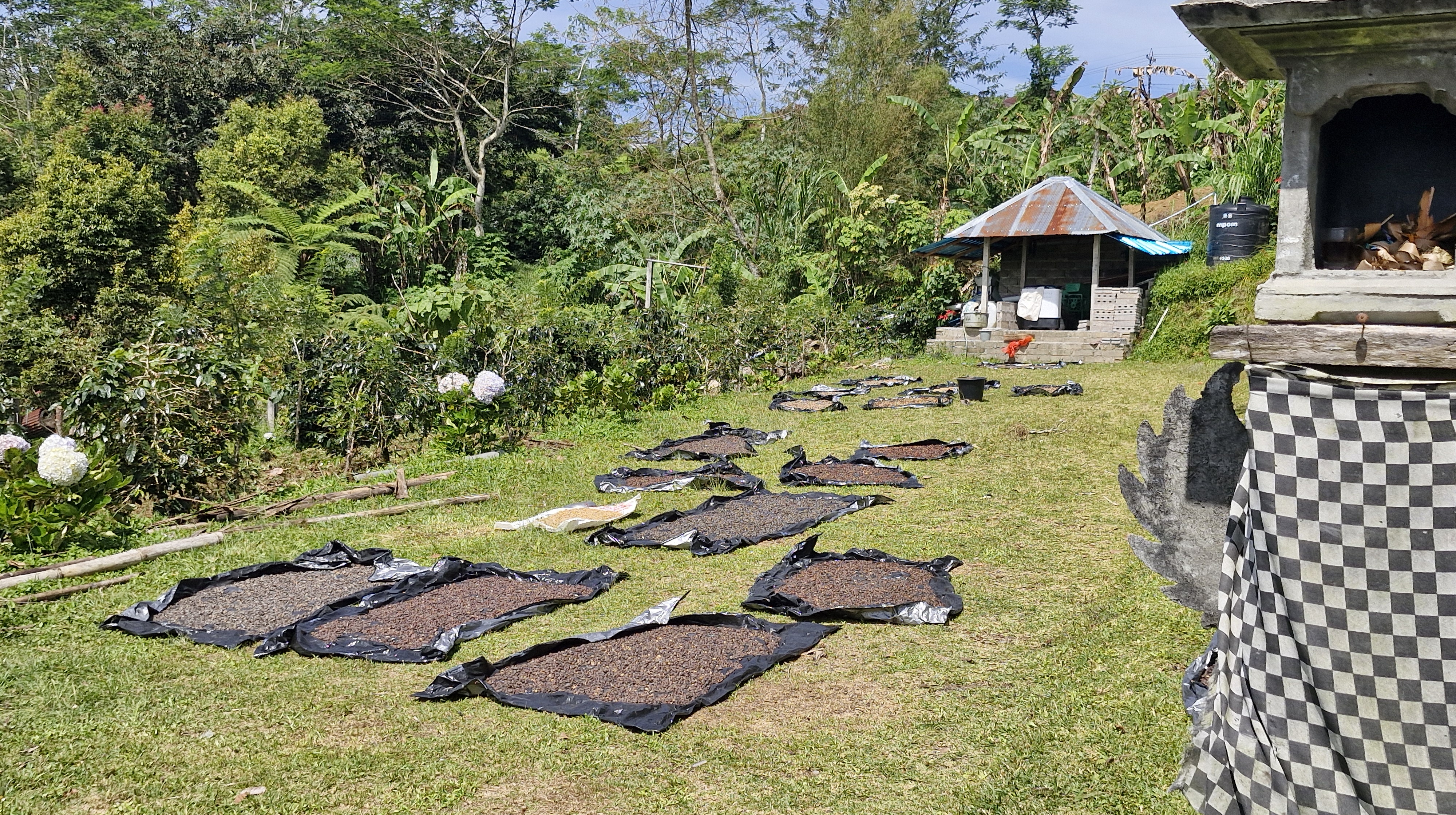


We traversed up and down the hillside embedded with rubber tires, which, in hindsight, I was quite grateful for. She showed me different trees that they plant here, including cinnamon (which I assume is Ceylon cinnamon and not cassia cinnamon that we in the west are more familiar with), vanilla, avocado (yes, they grow them here too), and banana. She also showed me several of the coffee bean trees where I was allowed to taste the sweet outer skin that the civets like. The whole tour was quite short-lived, perhaps fifteen minutes or so of walking and talking.
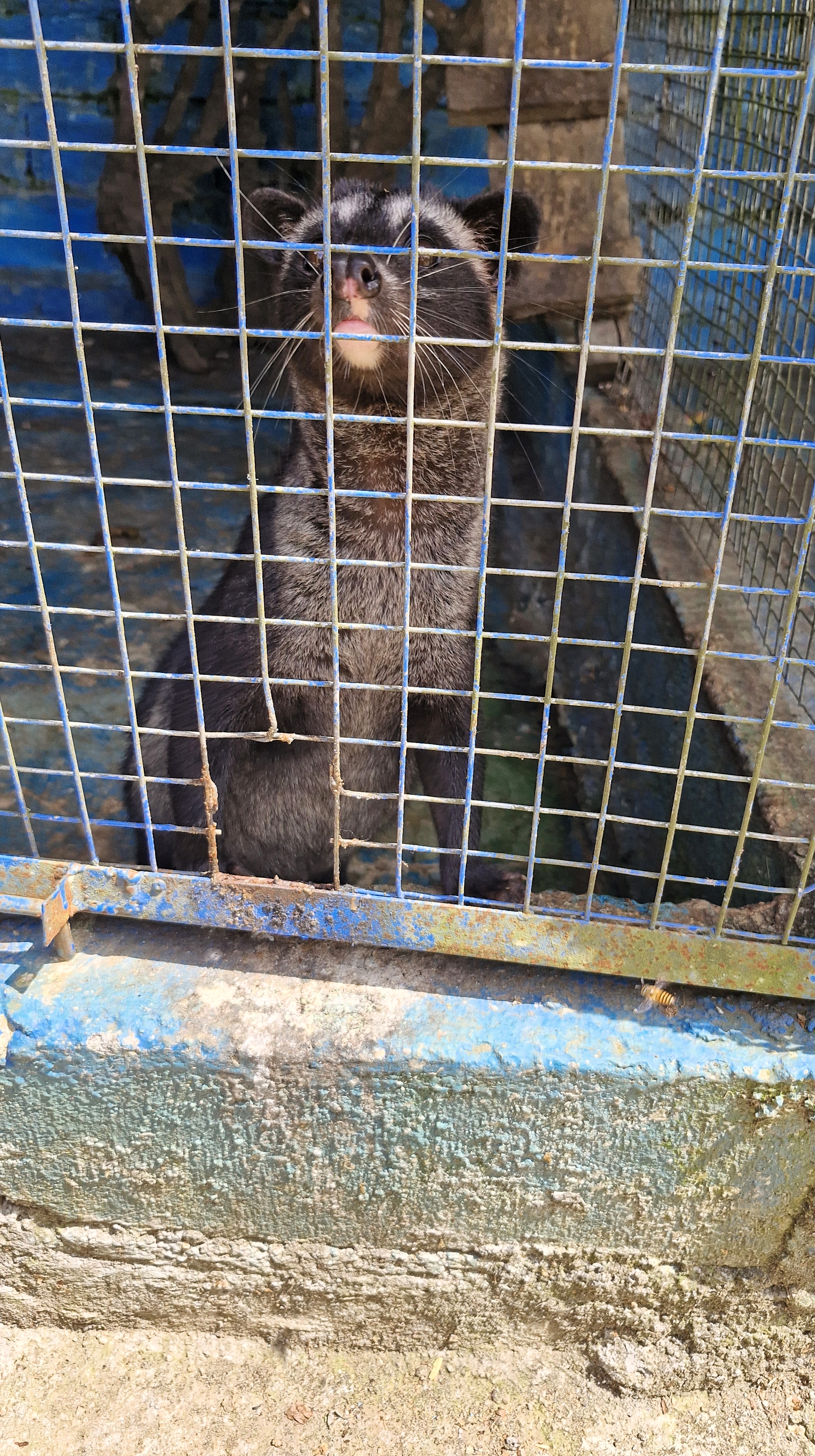
When we returned to the main site, on the way back toward the tasting area overlooking the valley, I also got to see some of the civets. While they didn’t look noticeably harmed, they were in cages, which seemed antithetical to the whole “humane” treatment that I had read about.



Back at the main tasting area, the wife of the owner then came out to greet me and for a discussion and tasting of the different kinds of coffee that they produce.

Some of them I could taste some slight difference whereas, some others I really couldn’t.


The reason I decided that I wanted to visit this particular coffee plantation is because of the reviews I read online about how the owner of this family-run plantation utilizes more humane practices. Anytime I can support businesses that focus on proper treatment of employees or animals (or as good as can be expected), I’m all for it. Did this particular plantation embody this? It was difficult to tell.
When the owner came out to greet me and chat, he talked about how he had begun putting the civets in cages to protect them from being shot and eaten by farmers. He said over time, the civets had begun eating up and destroying more of the crops, and so farmers began killing them off more and more.
You want the animals to be able to roam freely, but you also know that they are eating other farmers crops and, as a result, are continually being killed for it. I didn’t have a reason to think he was lying, and I wonder what other solution there is when you have this kind of problem, particularly when it’s clear that neither you nor any of your neighbors have that many resources to deal with this. Among other things, he discussed the following:
- Coffee beans are harvested in the summer months, and fruits (bananas and avocados) are harvested in the winter months.
- Lewaks (civets) are only interested in the outer skin of the coffee beans. Since they don’t physically have the capacity to fully digest the beans, they excrete them intact.
- His plantation also grows and sells Hortensia (Hydrangea), his biggest cash crop of all. He sells them almost weekly to be used in ceremonies and offerings.
- He grows avocados on shorter trees (trees that he purposely cuts short) so that they’re easier to retrieve (hit) with a stick. He said that these trees can grow quite tall, which makes it much harder to access the avocados, especially when needing to use a stick.
After chatting and trying all of the coffees, I took one last moment to thank him for the experience and to take in the scenery (and use the outside toilet) before heading off to the next site.
Banyuman Waterfalls
This was another place that was on my list, then off, then on again. Banyuman Waterfalls consists of four waterfalls. I only ended up seeing three due to not being able to figure out where the fourth one was. I was also a bit tired from the hiking (this was after I paid to get a motorbike ride down to the main area) and didn’t feel like taking more time to find it. This was another place that I wish I had more time for leisure so that I could have spent time in the water, like many of the other tourists did.


Wanagiri Hill-Buyan Lake
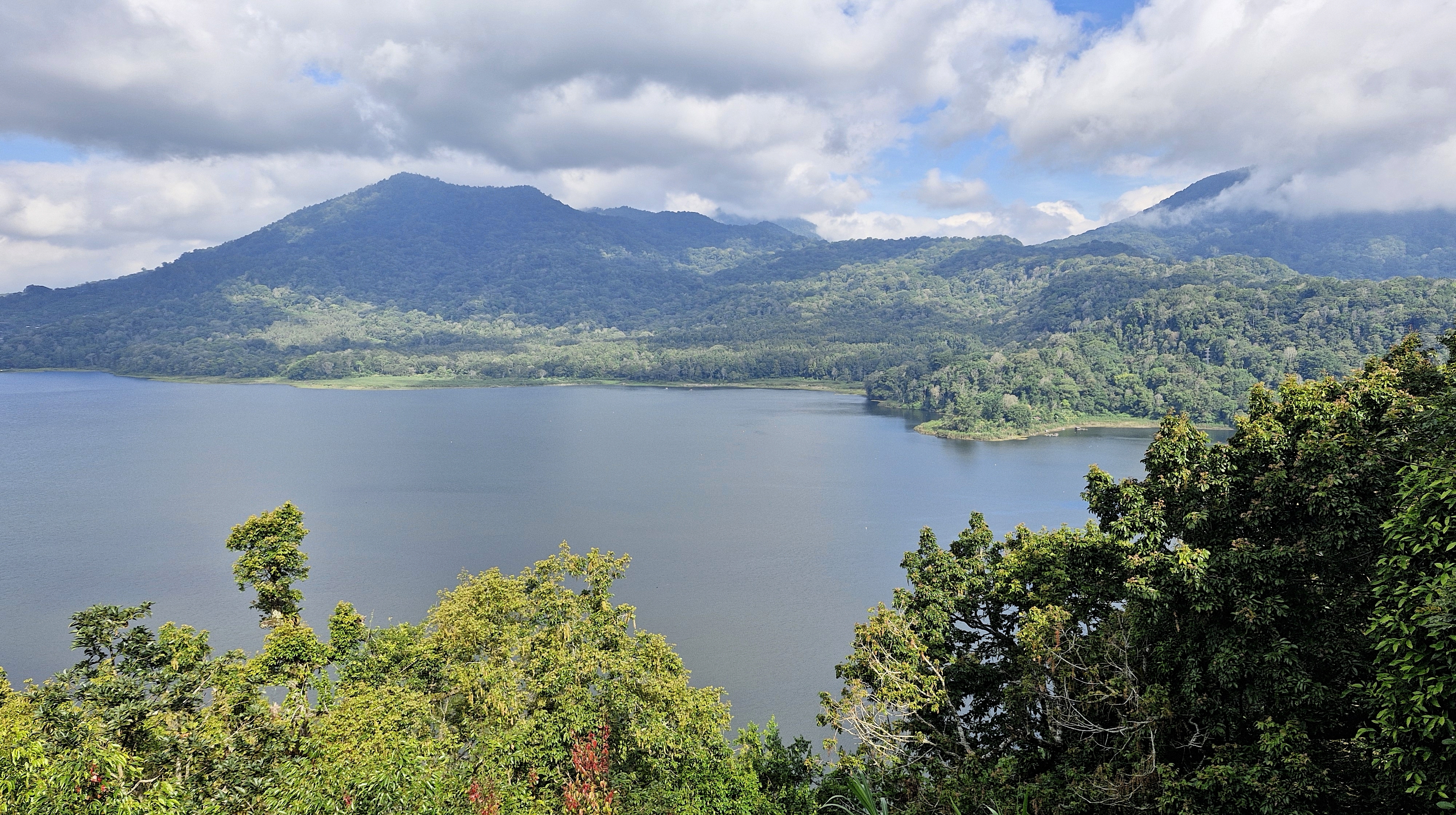
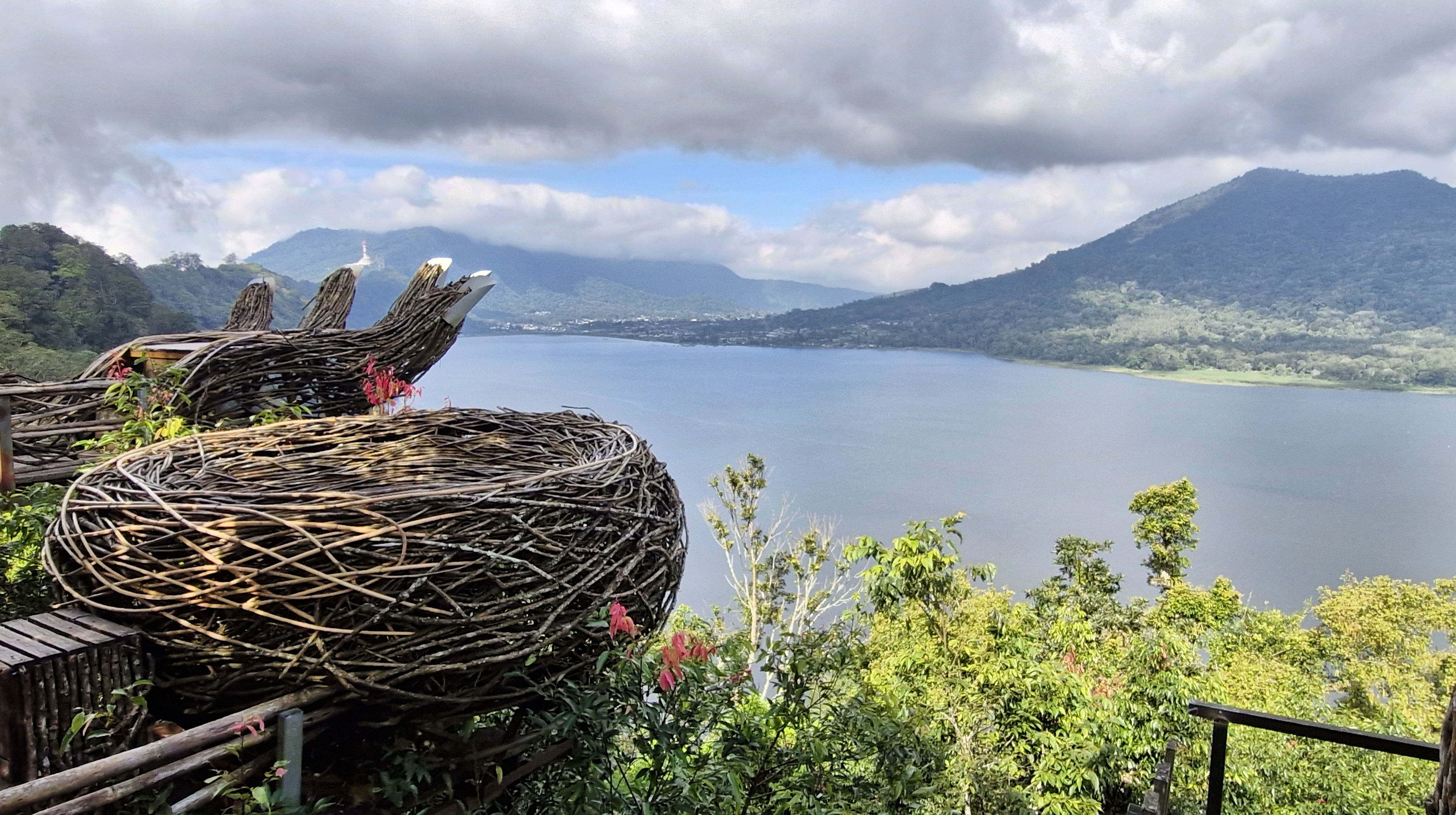
The driver asked yet again if there was any other place I wanted to see before Lovina. I couldn’t think of any, so he suggested stopping by Wanagiri Hill that overlooks Buyan Lake. I thought there might be more to see here, but there wasn’t. This put me off due to the ticket price. All this site is is a bunch of prop seating set up as a photo op for couples, but I’ve also seen images of people by themselves here. I think I spent a total of five minutes (maybe less) here. Some might debate whether this place is a tourist trap, but I would argue that it definitely is. This is why I have become such a control freak when it comes to creating an itinerary.


Now, onto the main events.
Menjangan Island

In choosing to see the dolphins, I also wanted to spend time at Menjangan Island for snorkeling/diving. Even though I would be sharing the same boat with other people, they were all (but one) going to be snorkeling. I was told that I was the only person diving with an instructor. The only other person was a seasoned diver and was going to be on his own. The last time I went diving was in 2019 in Thailand, specifically in Koh Tao, to get my PADI certification and dive for the first time. So, I was hoping this would be a fun sequel to that experience.
While in the small office (with the other tour group members gathered, trying on gear), I was told that there was one diving mask with a prescription. I was pleased to know that they had it. Whatever the prescription was, it was better than seeing blurry fish without it.
What I thought was going to hopefully be a fun return to ocean exploration ended up being a stress-inducing disappointment. By that, I mean that I experienced more problems with my breathing and getting used to it, as well as being comfortable with all of my diving gear. When I did my PADI certification, it was over the course of three or four days. Here, it was just a refresher while on the boat (I told the instructor that I had dived once before but that my certification was expired). In hindsight, I guess I should have opted for a PADI recertification course rather than a short refresher.
During the first dive, the water was relatively shallow, but I was having issues with feeling comfortable with my mask and my breathing. My concerns took up part of the diving time, and the instructor kept having to reassure me to relax and take more time to get used to it. Eventually, I was able to swim for longer, but I wished for better luck during the second swim after the lunch break.

The second dive was to be in deeper water. Once again, I flashed back to my second dive in Koh Tao. I had almost exactly the same concern (my mask) and it felt like it didn’t quite fit right. I was scared that I might have breathing issues once further down, not to mention other issues, like comfortably adjusting to the increased air pressure. Really, what is it with me and “the second dive”?
Instead of being able to work through my fear, I couldn’t get past the feeling that I might experience issues later on. Despite the instructor’s repeated suggestion (OK, begging and pleading) for me to relax, I just couldn’t shake the worry. He asked if I still wanted to dive, stating that it’s dangerous if I’m not able to focus properly. I told him that I didn’t want to continue and that I would just snorkel with the others.
I know that safety is most important; it’s just so disappointing for me when remembering how I was able to overcome my fear before, but this time, I couldn’t help but feel overwhelmed by it. I could sense disappointment by the instructor, although he agreed that snorkeling would be best. For someone like me who has been called “brave” and “ballsy” for the decisions I have made, I couldn’t help but feel like a failure, and that really stung.
The rest of the snorkeling was fine. I was able to snorkel all the way over to where the boat moved to. My instructor tried to encourage me about the distance I swam, but I didn’t really see it as much of an accomplishment since I’m a decent swimmer. Along the way, I did see some cool fish, as well as a sea turtle that was nudged from its resting place by one of the snorkeling instructors. I can’t say for certain if I will ever dive again, but I want to think that someday I’ll be able to face these fears (but with another proper PADI experience first).
Dolphins of Bali Sea

The big activity in this area is to see the dolphins. There are apparently 14 species of dolphins and whales that live in these waters. The two most prevalent are the “Spinners” and the “Frasers.”
It is common for people to come out here quite early in the morning, about 6:30 or so. This is when the dolphins are most active. I contacted the person running this tour about wanting to wait a bit later to go since I didn’t want to be one of 50+ boats all choking the waters and clamoring to get the best view. So, I was able to go out at 8:30.
The day started off to a rough start when I put in the wrong site name for the Grab driver (the main ride service used in Southeast Asian countries). I told the driver that we were going in the wrong direction. He thought we should continue on for a bit. After that, I insisted that we stop and check. Sure enough, I had typed in the wrong site since there is more than one temple site with a similar name. The driver politely suggested that I make sure to check carefully before turning around, as well as asked me to give him a five-star review considering the situation. Don’t worry, I did, along with giving him a tip, which was double the cost of the original drive. When we arrived, I met the operator of this tour, and he and the motorbike driver spoke briefly (I can just imagine what was being said). Our conversation was quite brief. I was told to wait until 8:30 for my boat to arrive. I signed up for a private boat tour, meaning it was just me and the boat driver.
I then walked over to the shoreline where the boats depart and dock. It was full of locals, some of whom were there trying to sell things to tourists. There wasn’t much discussion at all about the outing. Soon I was told to just hop into the boat and go out with the driver. No discussion about the actual snorkeling or the dolphins, just “Here is the boat; now you can go.” Earlier, I asked if there was a place to shower off, and he said yes. But while talking he never mentioned where it was.
While heading out I was in a sour mood. I had already “failed” in my previous attempt to dive again, I screwed up the site en route here, and now I was just being sent off on a boat with almost no discussion about the outing. I knew there would be other boats there, but once I actually saw them gathered together, it only stoked more irritation, as I don’t like big groups or crowds. It was definitely less than 50, but I couldn’t say how many there were for sure.
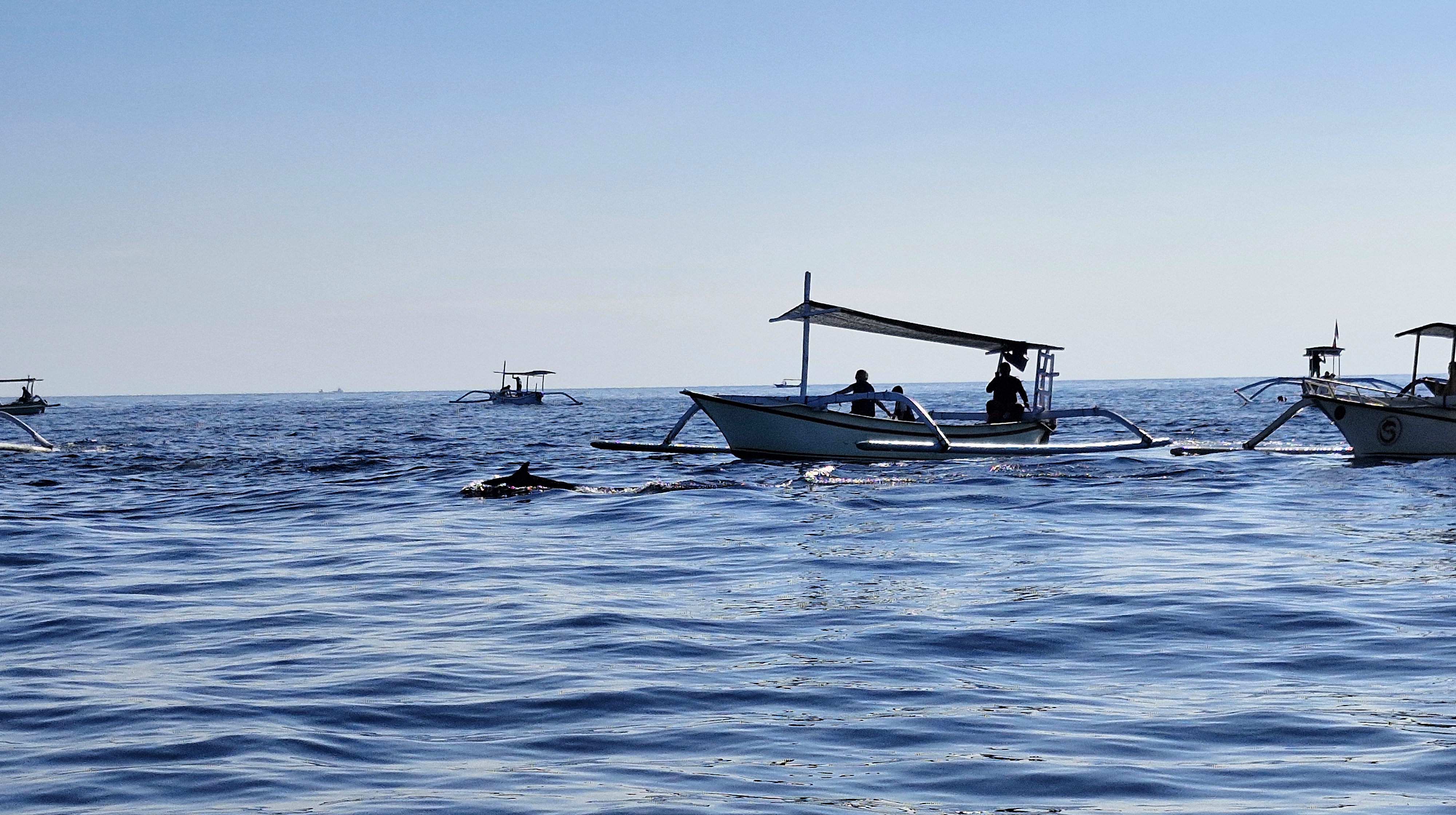
Once we arrived where the other boats were, the driver tried to ask if I wanted to snorkel and handed me the snorkeling mask. He then pointed to the front of the boat, where there was a bar on a rope. It’s what you hold on to while snorkeling. After the boat began moving for a bit, I then heard the driver say, “Look!” and point to where the dolphins were. To my surprise, while looking under the water, the dolphins soon passed by me, perhaps 20 feet or so, and swam downwards. My mood instantly switched to feeling joyous at having the chance to see them close like this. While it was difficult to tell what the distance was exactly (I was looking under the water without a prescription mask), they were close enough for me to see their slightly spotted bodies swimming past. It was the only time that I saw them this close, but it was still exhilarating.
The rest of the time was spent with me snorkeling some more before climbing back onto the boat and deciding to just focus on getting photos. I got some decent photos and videos on my phone.

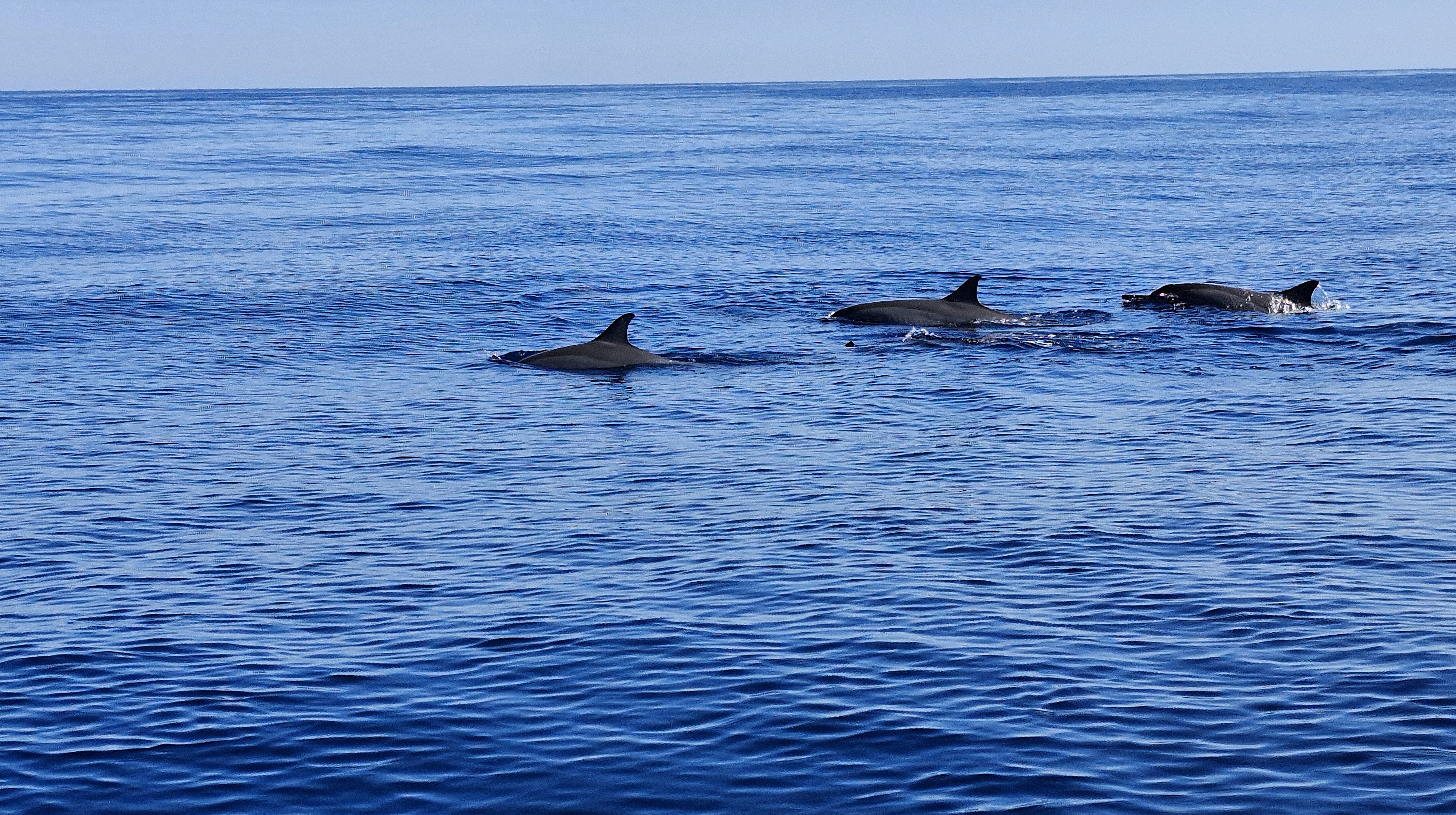
As to which dolphins were out there, I can’t be sure. I just remember that they were dark-skinned and seemed smaller than the bottle-nosed dolphins that many people think of.
As time went on, one by one, the boats thinned out until there were only a few of us left. I was enjoying the quiet and serene atmosphere and the sound of the water rippling as the boat moved up and down. The moment was briefly interrupted when a Chinese couple in one of the other boats decided to play some awful Chinese rap on their phone. Other than that annoyance, the rest of the time out here was nice.
I stayed until the timing felt right to head back to shore. I had read (and was told) that the outing could take three hours, but my trip finished in about two hours (including going out and heading back).

I was initially wondering what kind of an experience this would be. In the end, I was quite glad how it turned out. It seems like the kind of activity that could either be really good or quite disappointing. Much like the Wanagiri Coffee Plantation, I chose to go with this tour operator because it was listed as one of the operators that uses more humane practices (such as going out later when there are fewer boats and not following the dolphins too closely or chasing them). While I’m not sure if we “chased” them, I think I made the right choice by coming out here later and avoiding the huge swath of other boats.
Overall, this leg of the journey was both quite fulfilling and quite disappointing. The trip was only half finished, however, and what remained was Amed and Nusa Penida. Stay tuned.

Leave a Reply